
Product Center
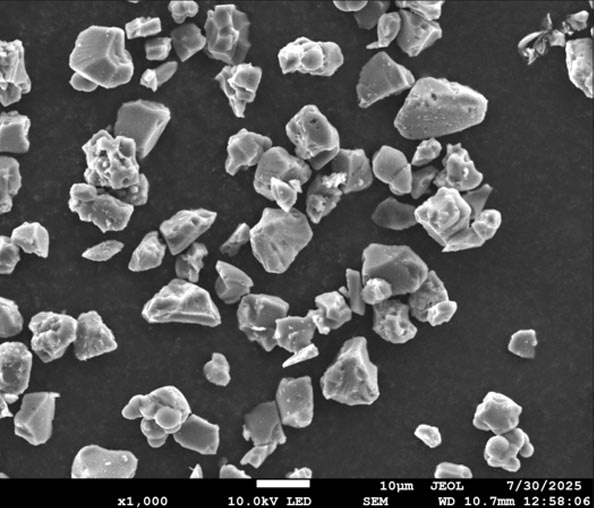
Low expansion, long cycle gas-phase silicon carbon negative electrode
Raw Material Selection
Selecting high-strength synthetic polymer based precursors as the carbon skeleton of gas-phase silicon negative electrode materials, optimizing the skeleton strength through molecular structure design to further reduce material expansion.
Raw-materials Thermal-treatmentTechnology
Unique heat treatment modification of resin precursors can reduce the inherent defects of materials during molding and pre carbonization stages, further enhancing the strength of the skeleton.
Porous Structure Regulation Technology
By precisely designing the reaction between the matrix and activator, directional drilling and optimization of the material structure are carried out, providing efficient deposition channels and filling gaps for silicon deposition.
| Product Model | Particle Size (μm) | SSA | Discharge Capacity @0.1C (mAh/g) | Initial Coulombic Efficiency@0.1C (%) |
|---|---|---|---|---|
| Dv50 | (㎡/g) | 1.5V mAh/g | 1.5V % | |
| KQ100-3F | 8.0±2.0 | ≤3.0 | 1900±100 | 91.5±0.5 |
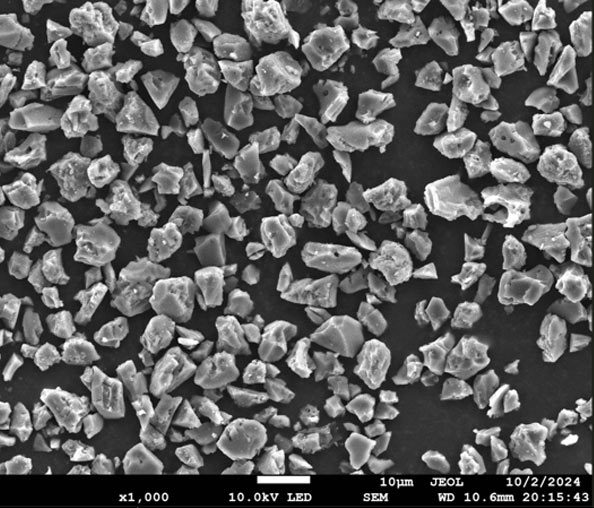
High energy density gas-phase silicon carbon negative electrode
Raw Material Selection
Selecting high-grade biomass precursor materials to prepare porous carbon skeleton materials with few defects, high pore volume, and low cost, further enhancing the cost-effectiveness of gas-phase silicon carbon products.
Porous Structure Regulation Technology
By precisely designing the reaction between the matrix and activator, directional drilling and optimization of the material structure are carried out, providing efficient deposition channels and filling gaps for silicon deposition.
Granular-fluidized Deposition Technology
By designing the flow field size, the skeleton particles are uniformly deposited in the form of fluid in the reaction atmosphere within the constant temperature field of the equipment, in order to obtain stable and uniform silicon carbon materials.
| Product Model | Particle Size (μm) | SSA | Discharge Capacity @0.1C (mAh/g) | Initial Coulombic Efficiency@0.1C (%) |
|---|---|---|---|---|
| Dv50 | (㎡/g) | 1.5V mAh/g | 1.5V % | |
| KQ200-1A | 7.5±2.0 | ≤3 | 2050±100 | 92.5±0.5 |
| KQ100-5 | 8.0±2.0 | ≤3.0 | 2300±100 | 94.5±0.5 |
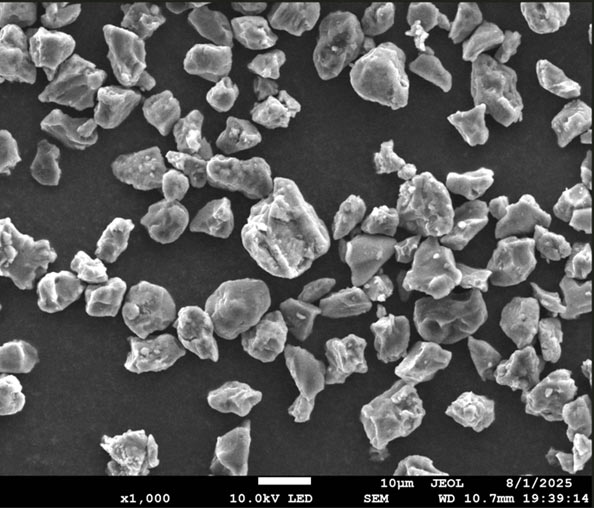
High power gas-phase silicon carbon negative electrode
Raw Material Selection
Selecting high isotropy, high conductivity, and low defect coke based precursors to enhance material kinetics and reduce intrinsic expansion of materials.
Particle Reforming Technology
Through advanced powder equipment and process technology, particles are precisely processed to obtain particle precursors with highly consistent size and morphology.
Porous Structure Regulation Technology
By precisely designing the reaction between the matrix and activator, directional drilling and optimization of the material structure are carried out, providing efficient deposition channels and filling gaps for silicon deposition.
| Product Model | Particle Size (μm) | SSA | Discharge Capacity @0.1C (mAh/g) | Initial Coulombic Efficiency@0.1C (%) |
|---|---|---|---|---|
| Dv50 | (㎡/g) | 1.5V mAh/g | 1.5V % | |
| KQ300-1 | 8.0±2.0 | ≤3.0 | 1900±100 | 91.5±0.5 |